
We take a look at the long history of surfski and outrigger canoe racing in the US: intro to the iconic Molokai Channel races in Hawaii, the Catalina Crossing in California, and the Gorge Downwind.
Organised each year in May, the Molokai Challenge is by far the most prestigious open ocean racing event that holds a long tradition. One of the oldest ocean open races in the world that has been organised every year since 1976, except for a hiatus of 3 years due to the global Covid pandemic (2020–22) with last year’s (2023) event being the 45th edition.
A 32 miles (52 km) crossing between the islands of Molokai and Oahu across the Kaiwi Channel (colloquially known as the Molokai Channel), it’s a true measure of one’s paddling and ocean navigating abilities as the channel is famous for its unpredictable weather conditions, often with strong wind and wave conditions.
The first ever crossing in an ocean-going kayak was achieved in 1976 by Dale ‘Doc’ Adams and it took him 7 hours and 30 minutes. He proved that it could be done and the next year he started to organise an actual race for an invitational-only group of elite surfski paddlers. To find an appropriate name in Hawaiian, Dale asked linguist Pilahi Paki to help him describe and name the event and he coined the term ‘Kanaka Ikaika’ which roughly translates as mankind’s respectful challenge of the great, mighty ocean’. This became the official name of the association that has been organising the race ever since.
The exact route of the challenge is always from Molokai to Oahu, with a start point in Molokai’s Papohaku Roadstead at the island’s westernmost beach and a finish line at Oahu’s Hawaii Kai harbour at the island’s southeastern tip. With today’s modern crafts, completing the challenge usually takes 3–4 hours with the speed records being pushed further each year. In 2007 the organisers tried extending the route to Waikiki Beach in Honolulu, adding an extra 8 miles (13 km) till the finish line but it turned out to be unpopular with one third of participants abandoning the race. This one-time, extended-length race was won by Tahitian paddling legend Lewis Laughlin in 5 hours and 20 minutes. It didn’t help that there was no wind at all and paddling 65 km on flat water requires real commitment.
While originally the race was mainly for elite surfski paddlers only, with the growing popularity of OC1 (modern, surfski-inspired individual outrigger canoes) in the ‘90s it became a second official category. In recent years, it has been made possible to participate as a relay team, with each paddler completing only a segment of the full distance, making it less elitist and more inclusive to paddlers of all levels, even though the potentially rough sea conditions are not for the faint-hearted. The challenge further inspired other island-to-island races within the Hawaii archipelago for other popular modalities such as OC6 and SUP.
Winning the Molokai is hard, very hard. Completing the race itself is hard! So coming in first place gives you fame worldwide, but winning it more than once makes you a legend. Here is a list of paddlers whose names are known across the surfski and outrigger canoe world thanks to their multiple wins at the Molokai Challenge:
Oscar Chalupsky
Probably the most well-known name in surfski, Oscar & his brother, Herman emerged as prolific paddlers in the South African lifesaving competition scene. Then in 1983 Oscar Chalupsky made it to the Molokai, won it in his first year, then won it every single year afterwards in the 1980s: that’s seven consecutive victories between 1983–1989. He then won the race another five times between 1995–2012, making his tally stand at 12 Molokai victories with the last one at age 60. Notable among these is the 1995 neck-to-neck race with his brother, in which the of them reached Oahu at the same time and decided to cross the finish line holding onto each other’s boats, making it the Molokai’s only-ever winners with a tie.
Dean Gardiner
If Chalupsky dominated the ‘80s, then Dean Gardiner ruled the ‘90s. With 8 consecutive victories between 1992–1999, and one more victory in 2001, the Australian paddler comes in second with a total tally of 9 victories in the surfski category.
Lauren Spalding
While repeating Chalupsky’s 12 wins might seem impossible, there is one other paddler with 12 gold medals at the Molokai! It’s the Hawaiian-born waterwoman and legend Lauren Spalding: 9x winner in the OC1 female category, and 3x winner in the surfski female category. To learn about Lauren’s experiences from growing up in an ocean paddling family in Hawaii to becoming one of the best female paddlers, and best multi-disciplinary paddlers of all times, inlcuding participating in the Olympics in K4, watch this documentary: Lean Against the Wind
Hank McGregor
Known for being an 11x world champion in marathon kayaking, the South African won the Molokai Challenge is 3rd in line among the Molokai surfski royalty, winning the challenge five times and setting the current speed record of 3 hours and 11 minutes in the 2019 race.
Lewis Laughlin
The Tahitian paddling legend won the challenge twice in 2007 and 2008, both times leaving McGregor behind in 2nd position. The 2007 win is notable for being the longest ever distance in the Molokai’s history (65 km).
Clint Robinson
The Australian paddler won the challenge three times in 2010, 2011, and 2013.
Cory Hill
Current ICF surfski world champ Cory Hill, also from Australia, had his first win in 2015, repeated it in 2018, and again in last year’s edition in 2023.
Without doubt one of the most important events in Hawaiian-style OC6 paddling is the yearly crossing of the Kaiwi Channel from Kawakiu Bay on Molokai's west site to Waikiki Beach on Oahu. The Moloka'i Hoe is organized by the Oahu Hawaiian Canoe Racing Association (OHCRA).
Returning with its 72nd edition in October 2024, the first Molokai Hoe was held on October 12, 1952 with only three canoes participating. Each year the event grew bigger and nowadays it is considered the OC6 world championship for the men’s crews, with over a thousand paddlers coming from all over the world. For the women's crews, a separate race, the Na Wahine O Ke Kai is held two weeks prior the men's race. The distance is the same for both crews at 59 km total (37 miles), with often rough conditions in the channel and a treacherous current just before Diamond Head and the finish line at Waikiki Beach that requires true seamanship to navigate. Each crew is supported by its own escort boat that follows them closely.
For clarification, in English-speaking countries the six-man canoes are often referred to as OC6 using the English abbreviation for ‘outrigger canoe’, while the official term, as mandated by the International Va'a Federation is V6, using the Tahitian word va’a (or wa’a, vaka, waka, wa in other Polynesian and Oceanic languages). The exact boat designs slightly differ from region to region, and the different organisations (OCHRA, IVF) have different standards for their races. Most races in Hawaii use an open cockpit OC6 model maintaining the form of traditional boats carved out of the trunk of a large koa tree. To take a glimpse into some of the early days of the Molokai Hoe, read this historic report filled with contemporary photographs and commentaries.

The Catalina Crossing has an even older tradition than the Molokai, and it’s a race specifically for the larger, 6-man outrigger canoes of Hawaii (OC6/V6). After a full year of preparations starting in 1958 to bring the sport of outrigger canoeing to mainland USA, this landmark event, a race between a two teams, one from Hawaii and one from California, was held on Sept 20, 1959 – exactly one month after Hawaii officially became the 50th state of the US. It involved two canoes shipped to California from Hawaii: traditional wooden boats carved out from the trunk of a koa tree, one named Melia meaning ‘calm waters’ that was used by the Hawaiian elite paddlers, and the other named Niuhe meaning ‘shark’, manned by the local Californian team who did some training in improvised canoes in the lead up to the event. This first event and the surrounding festivities were overseen by Duke Kahamamoku, the Olympic swimmer & surfing legend from Hawaii. The Hawaiian team won, completing the 32 mile (52 km) distance in 5 hours, and the California team arriving not far behind at 5 hours 11 minutes, with a start from Avalon on Catalina Island, and the finish line at Newport Dunes on the mainland.
Since then, the Catalina Crossing has become a tradition and has been held every year with an ever-growing number of OC6 (called V6 in Tahiti) canoes participating in it, organized by the Southern California Outrigger Racing Association (SOCRA). The route is always the same, between Avalon & Newport, but its direction depends on the wind forecast for the day (whether it’s from or to Catalina Island). The event helped in fostering a very strong outrigger canoeing culture in California, with a large number of active paddlers in Newport, while one of the original California crew members founded Dana Outrigger Team in 1972, a name well-known in the world of outrigger competitions as one of the strongest teams on US soil. Some original video footage of the 1959 race can be found on SOCRA’s YouTube channel. Today’s races are fully televised and due to the large number of teams is now organized over 2 days. The actual races can be watched through a live stream on Ocean Paddler TV’s channel, and here is their recap video of last year’s (2023) Catalina Crossing.
While it’s a relatively recent race event, with its first edition held in 2015, the Columbia River Gorge has long been known as the Mecca of all wind-based sports like kite and windsurfing, and in recent years it has increasingly became a destination for downwind paddlers in surfski, OC1, SUP or SUP-foil. The event has a 3-day window with the race itself being held on the day with the best conditions for a perfect downwind, from Home Valley to the Hood River Sandbar. The race is surrounded by all kinds of festivities lasting a total of 6 days. The Columbia River Gorge has some fantastic natural gifts: an almost constant, very predictable thermic wind that is channelled into and amplified by the gorge, forming a wind tunnel. The waves also carry on for much longer periods of time than at sea, so if you want to have that ‘no paddling, only surfing’ experience, the Gorge is the place to go! The original edition brought in 127 participants, in the second edition that number doubled to 250, and nowadays it’s over 300 paddlers competing with each other each year with more and more ‘celebrity’ paddler names popping up on the list. The official categories are: OC1 & surfski (both single and double), and SUP.
Here are some teasers from last year’s event: OC1 Men’s start, Surfski Men’s start, Women’s & Double’s start.
Cover image:
Drone photo of the racing canoes lined up at the start point of the Na Wahine O Ke Kai on Molokai
Photo credits:
Mike Wengler via OHCRA

If you are thinking of picking up sea kayaking this season, this is the article for you! We created a comprehensive comparison between traditional sea kayaking and surfski kayaking, both offered by our club, so you can understand their differences and decide which direction interests you.
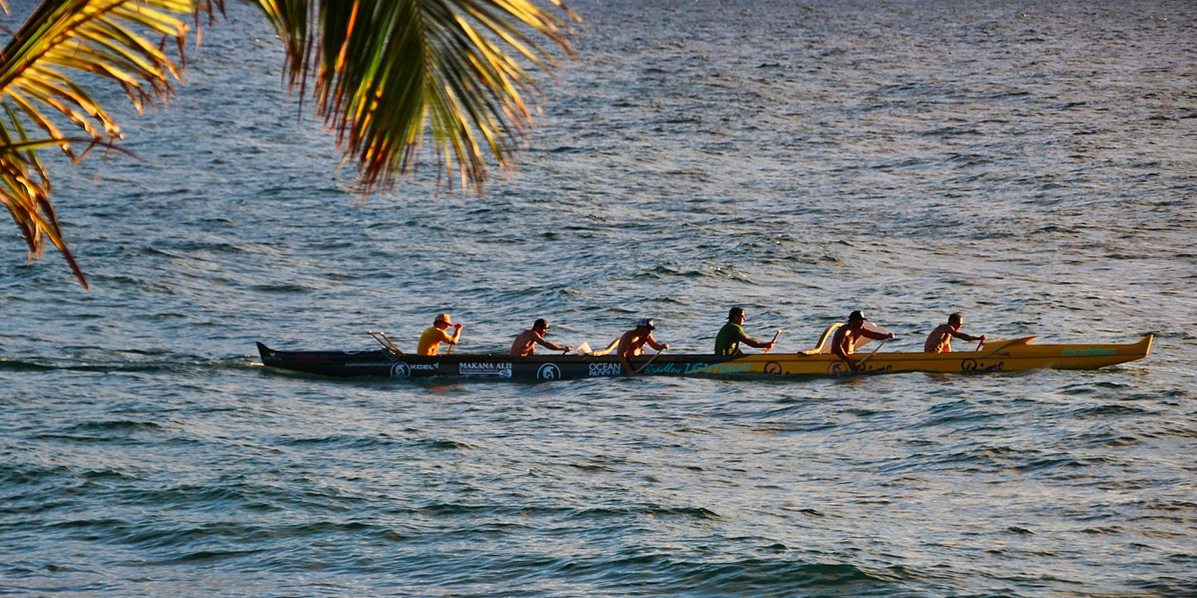
From its origins in navigating between the Polynesian islands to the modern competitive sport, we take a look at how outrigger canoeing or va'a has spread around the world, highlighting its major competitive events in Hawaii, Tahiti and Europe, along with the sport's most influential athletes and teams.
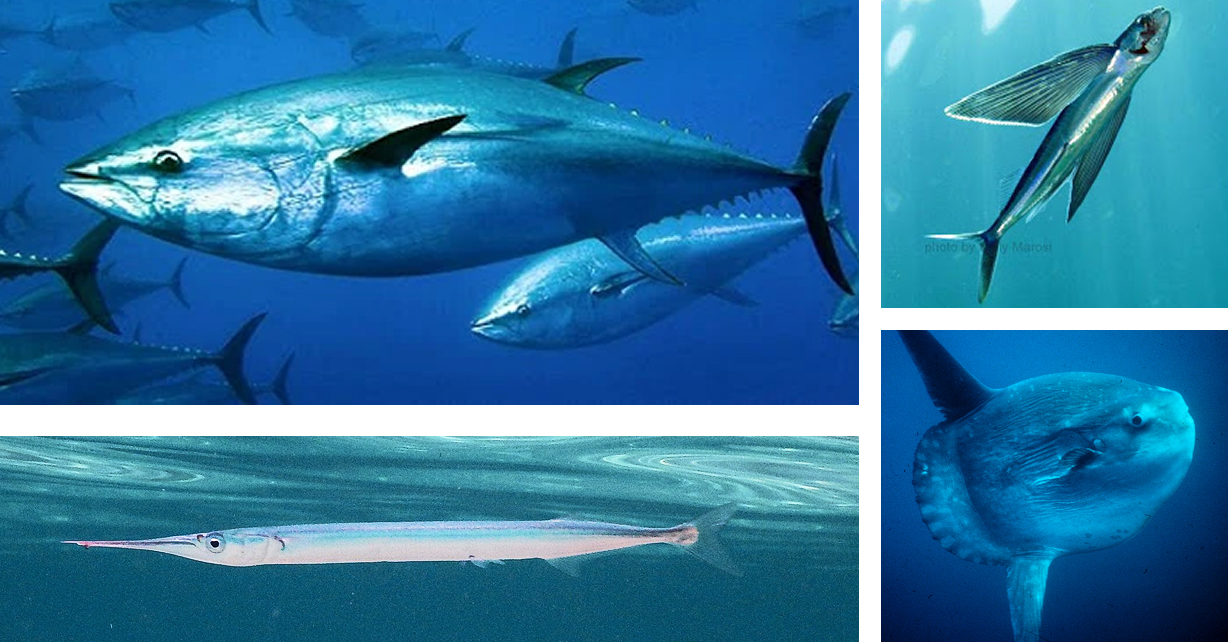
Parte de la magia de hacer deporte en el mar, ya sea en kayak, canoa, SUP, o remo, son los encuentros con la vida marina, que incluye una rica diversidad de peces en las aguas de Badalona. Aunque estamos cerca de la ciudad, de vez en cuando aparecen peces más grandes o poco comunes, como atunes enormes saltando del agua, el espectacular pez luna, el majestuoso pez espada, y el elegante pez volador.

Barcelona Caiac is a paddling school and sports club based in the Port of Badalona.
Founded in 2012, Barcelona Caiac has been pioneering ocean sports in Catalonia, being the first to establish a learning centre for surfski and outrigger canoe paddling, along with being the long-time base of a well-established group of traditional sea kayakers.
Situated in the sheltered waters of the Port of Badalona, we serve the ocean paddling community in the wider Barcelona & Maresme area.

Moll Lima, Port Esportiu de Badalona
Carrer d'Eduard Maristany, s/n,
08912 Badalona, Barcelona
info@barcelonacaiac.com


